

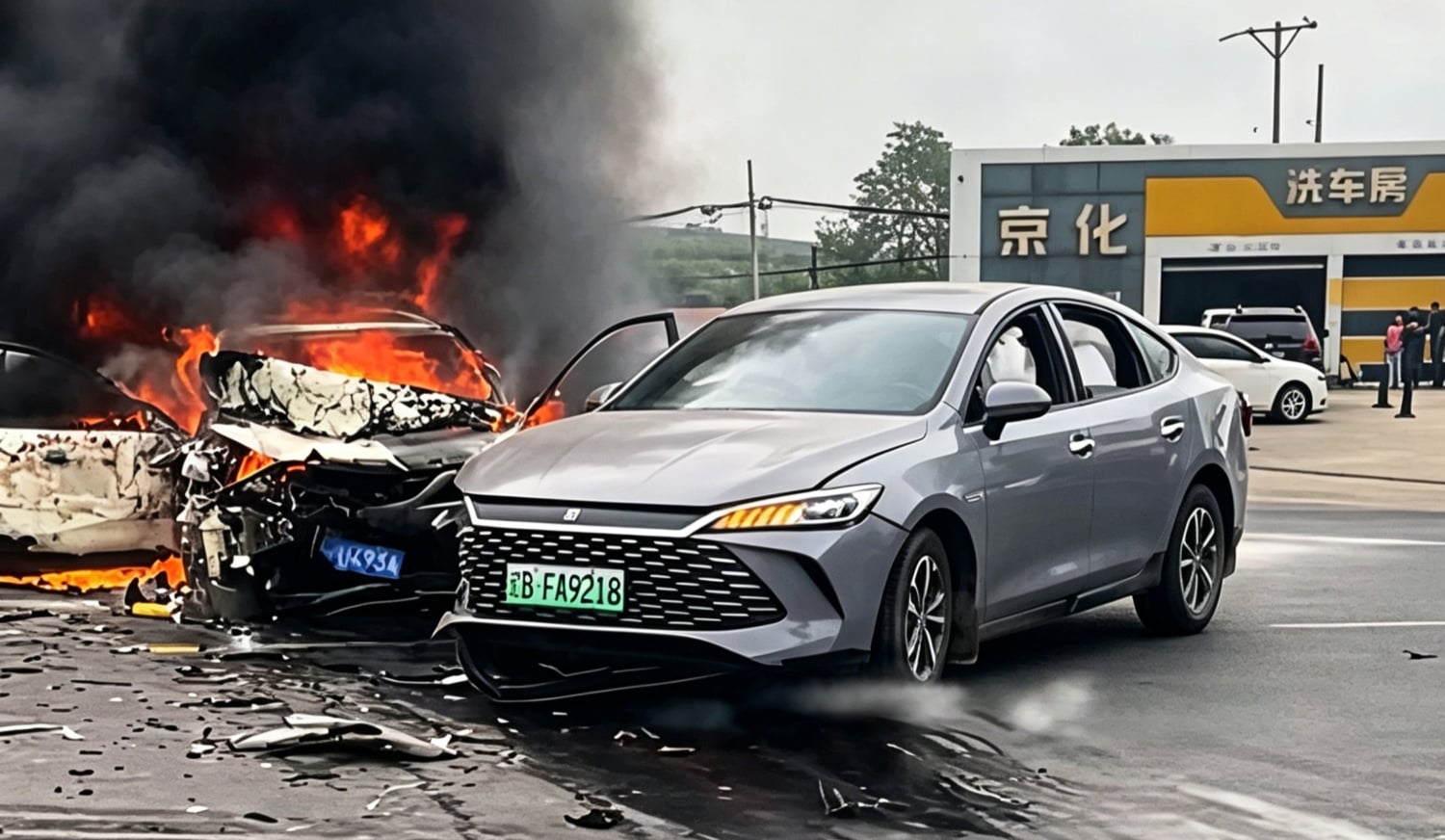
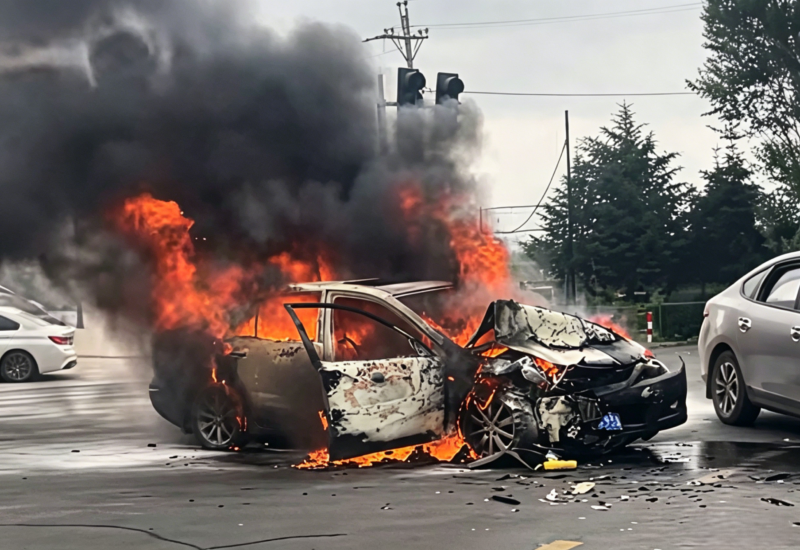
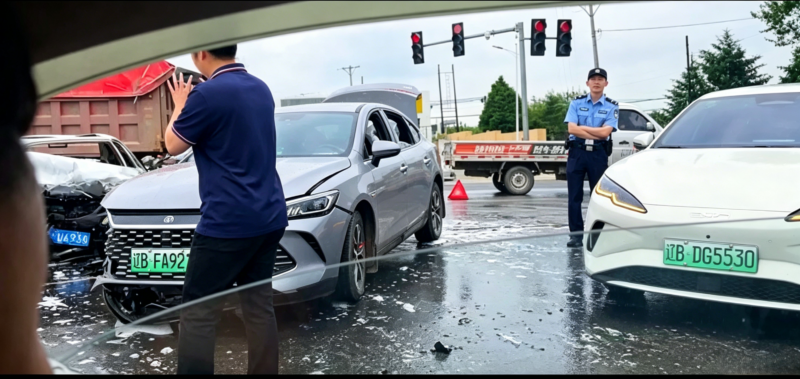
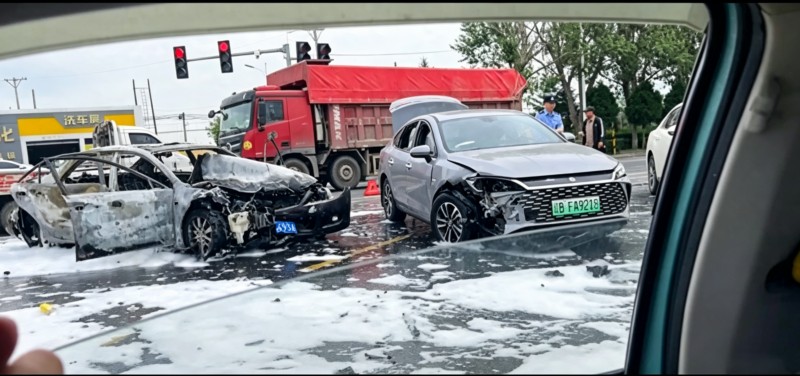
Viral footage from Dalian, Liaoning Province, has captured a dramatic collision that challenges common assumptions about electric vehicle fire risks. A BYD Qin L plug-in hybrid sedan, heavily damaged in a 45-degree offset impact with a gasoline-powered car, kept its battery intact and fire-free. In contrast, the other vehicle—a third-generation Mazda 3 Axela—burst into flames shortly after the crash.
The BYD Qin L, a plug-in hybrid, sustained severe front-end damage but its integrated lithium-iron phosphate blade battery pack remained completely secure. No thermal runaway occurred, as onboard sensors instantly triggered an automatic high-voltage power cut-off. All occupants evacuated safely before emergency services arrived, with no reported fatalities or injuries.
According to TT, the accident involved a 45-degree angled impact that directed deceleration forces through the front crumple zones of both vehicles. The Mazda 3, a compact sedan manufactured between 2014 and 2019, suffered a ruptured fuel system, leading to rapid ignition. Its identity was confirmed by visible door contours, wheel arch geometry, and side window silhouettes despite extensive thermal damage.
Analysis of the crash location, based on the BYD's registration plate (辽B FA9218), places the incident within Dalian city limits. Background infrastructure, including a Jinghua Car Wash facility, overhead utility poles, traffic light configurations, and roadside evergreen trees, matches local municipal features.
Battery Safety Systems in Action
The BYD Qin L's safety systems acted within milliseconds. The integrated lithium iron phosphate blade battery cells, known for their highly stable materials that resist oxygen release during physical deformation, kept the floor-mounted battery pack entirely inert. Immediate high-voltage circuit isolation prevented any electrical arcing across damaged hybrid powertrain components.
Impact forces concentrated on the front wheel area triggered automatic dual airbag deployment and an immediate transmission gear lock. This post-collision protocol keeps the vehicle stationary, preventing manual relocation away from the nearby combustion fire. Onboard safety links permanently cut electrical pathways to protect the passenger chassis.
Vehicle fire safety is a highly scrutinized performance metric in the Chinese domestic market. Industry discussions often contrast real-world impact resilience against external vulnerabilities, such as poplar fluff fires destroying fleet vehicles. Incidents like spontaneous combustion of sedans in traffic highlight ongoing engineering efforts to develop crash-triggered isolation protocols.
Market Delivery Trends
The BYD Qin L hybrid model targets a competitive mass-market segment priced under 150,000 yuan (approximately 21,000 USD). According to China EV DataTracker records, domestic deliveries reached 10,019 vehicles in May 2026. This reflects a contraction from the 31,304 units tracked during its peak market expansion phase in June 2025.