

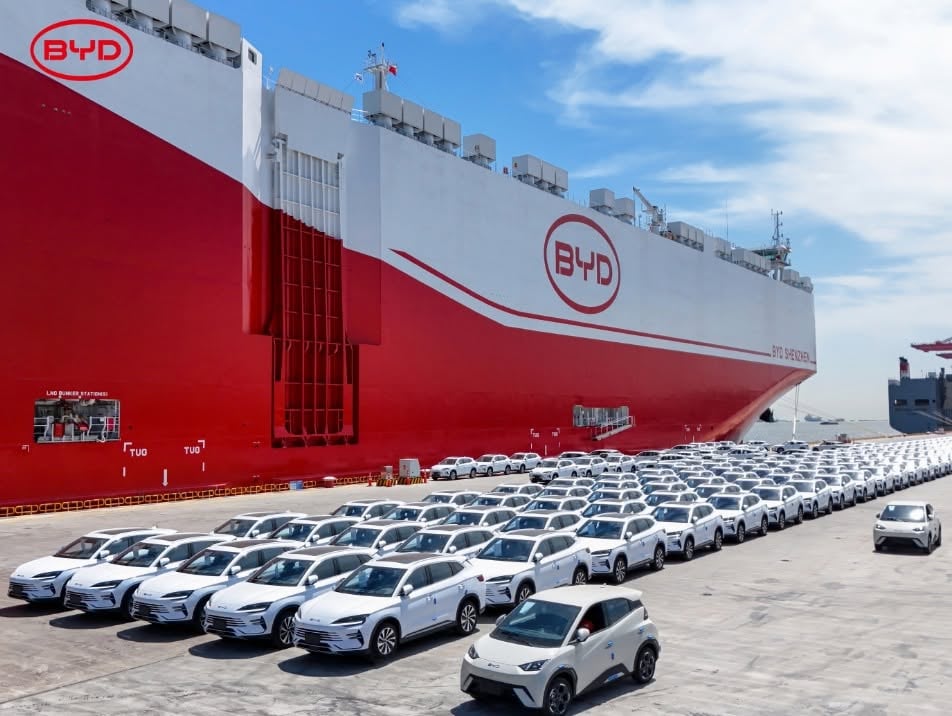
The Australian Automotive Dealer Association (AADA) has released a forecast indicating that vehicles manufactured in China will capture 58% of Australia's new car market by 2035, which translates to roughly 900,000 units per year. This prediction is based on June sales data, which revealed that Chinese-made vehicles already accounted for 35.5% of the Australian market.
AADA noted that the pace of this shift has exceeded earlier expectations. The latest projection is significantly higher than a previous estimate from the Australian Centre for International Economics, which had predicted a 43% market share by 2035.
According to AADA CEO James Voortman, the June new vehicle sales results indicate that the transition to electric vehicles is advancing more rapidly than previously forecast, particularly for Chinese manufacturers. China has already surpassed Japan as Australia's largest source of new vehicles.
In June 2026, Australian buyers purchased 46,592 vehicles made in China, representing 35.5% of the market, as per VFACTS data. Japan ranked second with 27,098 vehicles (20.7%), followed by Thailand with 23,297 units, South Korea with 14,863 units, and Germany with 5,731 units.
The shift is also reflected in brand rankings. Toyota remained the top-selling automaker in Australia in June with 19,124 vehicles, but BYD came in a close second with 18,881 units—a difference of just 243 vehicles. Chinese brands GWM and Chery secured the eighth and ninth positions, respectively.
AADA expects the number of brands competing in Australia to grow from 67 currently to 75 by 2031, as more automakers enter the market. Since 2010, ten new automotive brands have entered Australia, nine of which manufacture their vehicles in China.
Electric vehicle adoption is accelerating
During the first half of 2026, Australian buyers registered 103,843 battery electric vehicles (BEVs), a 119.8% increase year-on-year, according to data from the Federal Chamber of Automotive Industries (FCAI) and the Electric Vehicle Council (EVC). BEVs accounted for 16.4% of Australia's new vehicle market in this period, up from 7.6% in the first half of 2025.
BYD emerged as Australia's best-selling BEV brand in the first half of 2026, with 29,192 vehicles delivered—a 241.2% increase year-on-year. Tesla followed with 23,588 units, up 66.7%. BYD held 28.1% of Australia's BEV market, while Tesla had 22.3%.
Geely ranked third with 6,756 BEVs, ahead of Kia with 6,204 units. Chery-owned Jaecoo placed fifth, followed by Geely-owned Zeekr. The Tesla Model Y remained the best-selling individual BEV model, with 20,396 deliveries in the first half of the year, followed by the BYD Sealion 7 with 12,516 units and the Geely EX5 with 6,756 units.
In June alone, Australia recorded 32,570 BEV sales, equivalent to 23.3% of new vehicle sales. An estimated 80% of the BEVs sold in Australia during that month were manufactured in China. Chinese automakers continue to expand their Australian lineups. For example, Xpeng recently announced plans to launch five vehicles in the country within six months, with some products arriving around the same time as their introduction in China.
Australia becomes increasingly important for Chinese exports
According to Chinese industry data, China exported over one million vehicles in June 2026, marking the first time monthly vehicle exports exceeded that level. New energy vehicles (NEVs), which include BEVs and plug-in hybrids (PHEVs), accounted for 523,000 units of that total.
Australia is particularly vulnerable to changes in global vehicle production, as it no longer has large-scale domestic passenger car manufacturing and relies entirely on imports. China's growing share of Australian sales reflects both the expansion of Chinese automakers overseas and a broader shift in the types of vehicles supplied to the market.
AADA described this development as one of the most significant transformations in the history of Australia's automotive market, driven by changing consumer preferences, electrification, and the arrival of new brands.