

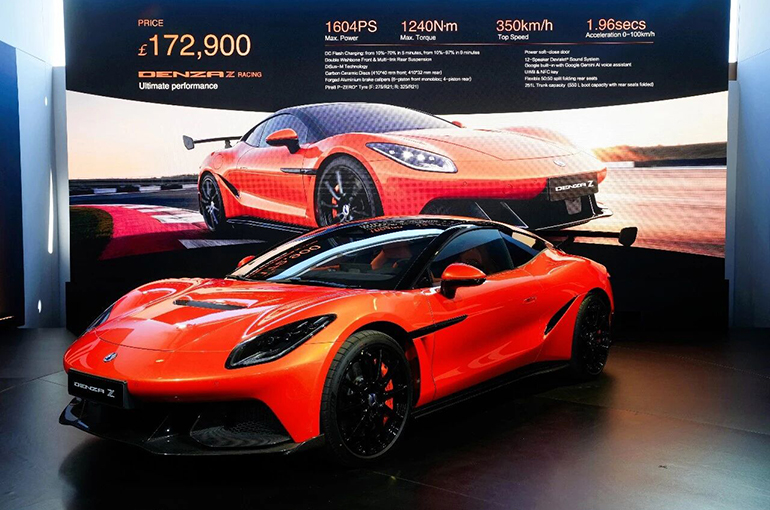
Chinese automaker BYD has joined a growing list of domestic car manufacturers launching new models overseas before bringing them to China, pricing the vehicle at nearly three times the domestic cost. This strategy comes as falling demand at home pushes Chinese carmakers to rely more heavily on global sales for growth.
Pre-sales for BYD’s Denza Z electric supercar began in China yesterday, just four days after its European debut. The domestic price tag of CNY680,000 (USD100,300) is significantly lower than the international price. In the United Kingdom, where the car first launched, prices range from GBP142,900 to GBP172,900 (USD191,300 to USD231,500).
Cui Dongshu, secretary-general of the China Passenger Car Association, explained that Chinese automakers often command higher prices abroad due to import tariffs in various countries. He added that cross-border logistics, overseas labor, strict certification requirements, and localization costs also contribute to the price gap. Additionally, less intense competition in overseas markets allows automakers to achieve wider profit margins.
An analysis by Yicai of publicly available data reveals that at least four Chinese auto models are priced at least three times higher overseas than in China, including the Geely Galaxy E5 and BYD Han EV. More than ten other models are sold abroad for between 1.5 and 2.5 times their domestic price.
The overseas-first launch strategy is already showing early signs of success. BYD Executive Vice President Li Ke reported that the Denza Z generated strong initial interest after its UK debut, securing nearly 20 orders from Serbia on the first day alone. The model has also attracted orders from other European markets and several countries in the Middle East.
Xpeng Motors is adopting a similar global-first approach. Its Mona L03 is scheduled to launch in Germany before entering the Chinese market. Chairman and CEO He Xiaopeng said European sales have climbed this year, and the company plans to adjust its launch planning for future global products, targeting the international market from the outset.
Global sales have become increasingly important for Chinese automakers this year. According to data from the CPCA, domestic auto sales reached 9.921 million units in the first half, down 21 percent from a year ago. In May, sales fell 22 percent year-on-year to 1.53 million. Meanwhile, amid a surge in demand for new energy vehicles abroad, China’s first-half car exports soared 65 percent from a year earlier to 5.096 million units.